



All TransportDepot Inc. coordinates commercial heavy machinery shipping to South Africa from the USA for mining operations, civil construction, agriculture, equipment dealerships and industrial projects. Export cargo may include excavators, graders, loaders, crushers, tractors, cranes and commercial trucks routed toward Durban, Richards Bay, Cape Town or another carrier-approved gateway.
South Africa planning should connect the ocean route to the final operating region. Machinery intended for Gauteng, KwaZulu-Natal, Western Cape or a remote mining site may require different port selection, heavy-haul permits, escorts, lifting arrangements and inland delivery schedules, so ATD reviews the complete cargo profile before booking.
For a complete overview of ocean methods, cargo requirements and quotation preparation, see ATD’s heavy machinery shipping services from the USA.
🚢 Ship with Confidence. Partner with Top NVOCCs and leading global ocean carriers.
👉 Get a Rate:
https://alltransportdepot.com/roro-shipping-cost/
👉 Place Your Order:
https://alltransportdepot.com/place-order/
📲 WhatsApp: +1 (470) 791 4497
📞 Call: +1 (678) 528 5794
📧 Email: ship@alltransportdepot.com
Heavy Machinery Shipping Calculator
Loading........
Commodity Description
Unit System
QTY
Length (m)
Width (m)
Height (m)
Weight (KG)
Volume
0.00Estimated Total
0.00
Client Info – Associated With Quote Request
Commercial Machinery and Project Cargo for South Africa
This page is for business equipment logistics rather than personal vehicle shipping. A running loader may be suitable for RoRo, while a large crawler excavator, drill rig, crane, industrial module, or multi-unit fleet may require flat rack, breakbulk, or a project-cargo plan. The final method depends on technical cargo data and current carrier acceptance.
Commercial shipments commonly include:
- Mining, quarry, drilling, crushing, and screening equipment
- Excavators, bulldozers, wheel loaders, graders, and backhoes
- Mobile cranes, telehandlers, forklifts, and aerial work platforms
- Agricultural tractors, harvesters, implements, and irrigation machinery
- Dump trucks, concrete equipment, road rollers, and fleet vehicles
- Generators, compressors, pumps, and industrial production machinery
- Buckets, booms, blades, counterweights, spare parts, and attachments
Technical Cargo Review Before Quoting
A commercial rate cannot be calculated responsibly from the destination alone. ATD first reviews the year, make, model, equipment type, serial number when available, exact length, width, height, operating weight, pickup location, and running condition. Photographs from every side help identify protrusions, damaged components, track or tire configuration, ground clearance, and the loading access available at origin.
Oversized and heavy units may also require axle weights, center-of-gravity information, lifting diagrams, certified lifting points, or manufacturer specifications. These details influence truck selection, highway permits, terminal handling, vessel planning, and cargo securing. Measurements should represent the actual transport configuration, including any bucket, boom, blade, cab, tire, or counterweight that will remain attached.
Dismantling decisions
Dismantling can reduce the transport envelope, but it adds labor, lifting, packing, inventory control, and reassembly requirements. ATD compares assembled and reduced dimensions before determining whether dismantling produces a practical freight advantage. Every removed component should be labeled, photographed, and tied to the correct parent machine.
Shipping Methods to South Africa
RoRo shipping for operable equipment
Roll-on/roll-off service may be available for machinery that runs, steers, and brakes safely. It can reduce lifting and dismantling for self-propelled cargo, but acceptance depends on the carrier, port pair, dimensions, weight, clearance, mechanical condition, fuel level, and any loose attachments. Carrier approval must be secured before the equipment is transported to the U.S. terminal.
Container shipping for compact machinery and parts
Standard or high-cube containers may suit compact equipment, generators, spare parts, attachments, or machinery dismantled within container door, internal-dimension, payload, and weight-distribution limits. Cargo must be professionally blocked, braced, and secured. Removed parts should be packed and documented so the destination team can identify and reassemble them correctly.
Flat rack shipping for out-of-gauge cargo
Flat rack service can accommodate cargo that is too wide or too high for a closed container. The shipment typically requires lifting, carrier approval, blocking, bracing, lashing, and out-of-gauge planning. Pricing is based on the final shipping dimensions and weight, not only the equipment model.
Breakbulk and engineered project cargo
Breakbulk may be required for mining machinery, cranes, large tracked equipment, industrial modules, or cargo that cannot use RoRo or container equipment. These movements can require an engineered lifting plan, center-of-gravity data, terminal crane coordination, certified lifting points, and precise scheduling between the inland truck and vessel operation.
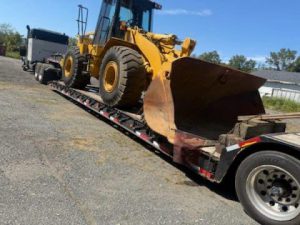
Commercial heavy machinery prepared for export
Heavy-Haul Pickup and U.S. Port Delivery
Machinery can be collected from a dealer, auction, mine supplier, jobsite, farm, factory, storage yard, or warehouse. Depending on the machine profile, inland transport may use a flatbed, step deck, lowboy, removable gooseneck, or another permitted heavy-haul configuration.
The pickup plan should confirm site access, loading equipment, machine operability, permit needs, escorts, route restrictions, export-terminal receiving hours, and vessel cutoff. A non-running unit may require towing, winching, a crane, or a forklift. These arrangements should be made before dispatch to avoid failed pickups and port delays.
Blocking, Bracing, Lashing, and Export Preparation
Preparation can include cleaning the equipment, lowering or securing booms, locking articulating sections, protecting exposed components, removing loose accessories, reducing fuel when required by the carrier, and confirming that prohibited material is not stored inside the machine.
Container and flat rack shipments need a securing plan that accounts for weight distribution and expected movement during trucking, terminal handling, and ocean transport. Chains, straps, blocking, bracing, and attachment points must be suitable for the cargo. Large project shipments may require securing calculations or supervision by specialized service providers.
Export Documents and South African Consignee Readiness
The U.S. export file varies by equipment type and ownership, but commercial shippers should be prepared to provide:
- Commercial invoice or bill of sale
- Title or ownership evidence when applicable
- Exporter and consignee information
- Equipment description, year, make, model, and serial number
- Packing list for attachments, parts, and multiple units
- Dimensions, weight, photographs, and running-condition details
- Authorization or power-of-attorney documents when required
- Carrier- and terminal-specific forms
The consignee should confirm current South African import controls, customs classification, taxes, inspections, permits, and clearance procedures with a qualified local customs broker before booking. ATD coordinates the agreed export and ocean-freight scope; destination customs advice and local regulatory approval remain separate unless expressly included in writing.
Durban, Cape Town, and Destination-Port Planning
Durban routing
Durban is a common commercial gateway for containerized, RoRo, breakbulk, and industrial cargo, subject to carrier service and terminal acceptance. It may be relevant for equipment serving projects in eastern and inland markets. The final inland route should be checked for weight, height, and permit constraints before selecting the port.
Cape Town routing
Cape Town may suit cargo connected with the Western Cape or routing supported by the selected carrier. Availability for a particular machine depends on the shipping method, vessel schedule, terminal capability, and the cargo’s final dimensions.
Other South African port options
Other ports may be considered when carrier service, project location, or cargo type supports them. Port selection should balance ocean availability, terminal handling capability, customs arrangements, and final inland delivery—not simply geographic distance.
Fleet, Mining, and Construction Project Coordination
Multi-unit shipments require an equipment register that connects each serial number with its photographs, dimensions, ownership documents, attachments, and pickup location. ATD can coordinate pickups from multiple U.S. origins, consolidation at an export facility, dismantling schedules, and sequenced terminal deliveries.
For mining and construction projects, the shipping plan should allow time for seller release, inland permits, cargo preparation, carrier approval, export documentation, terminal receiving, and vessel cutoff. Destination lifting and heavy-haul resources should also be reserved before arrival when the cargo cannot leave the terminal under its own power.
What Determines the Commercial Shipping Cost?
Cost depends on the machine’s final transport dimensions, weight, condition, pickup point, inland trailer, export port, selected ocean method, carrier space, terminal handling, securing, lifting, dismantling, documentation, and destination arrangement. A website range cannot represent both a compact forklift and a large mining excavator accurately.
For a project-specific quotation, send:
- Year, make, model, and equipment type
- Exact length, width, height, and operating weight
- Running, steering, and braking condition
- Pickup ZIP code and loading conditions
- Clear photographs from all sides
- Attachment and removable-component list
- Preferred destination port and final project location
- Number of units and required shipping window
Request a commercial machinery shipping rate or place an order after the cargo profile and routing are confirmed.
Preparing the machinery and its supporting records before pickup helps prevent terminal rejection, carrier delays and avoidable handling charges. Final requirements vary by carrier, terminal, cargo type and destination. Oversized cargo: lifting diagrams, center-of-gravity data, axle weights, route studies, permits or crane plans may be required before dispatch.Equipment Preparation and Export Documentation
Machinery Readiness
Document Readiness
Frequently Asked Questions
Can ATD ship non-running machinery to South Africa?
Yes, subject to carrier and terminal acceptance. Non-running equipment may require winching, towing, lifting, flat rack, container, or breakbulk handling. The exact mechanical condition must be disclosed before booking.
Can several machines move under one project?
Yes. ATD can coordinate a multi-unit export plan, including equipment from several U.S. origins. Every unit still needs its own specifications, photographs, ownership documents, and attachment record.
Are South African duties and customs clearance included?
Only items expressly listed in the written quotation are included. The consignee should verify duties, taxes, permits, inspections, brokerage, terminal release, and inland delivery with qualified South African providers.
How long does shipping take?
Timing depends on equipment readiness, inland permits, documentation, carrier approval, vessel space, sailing schedule, transshipment if applicable, weather, and destination clearance. Request a current routing estimate for the actual machine and port pair.

Ruth Kendi writes and reviews international shipping guidance for All TransportDepot Inc., with a focus on commercial machinery, RoRo service, container shipping, export coordination and destination planning. All TransportDepot Inc. has been in business for 20 years and operates as an FMC-licensed NVOCC (License No. 021693) from 2305 Fourth Street, Suite B, Tucker, GA 30084. The company coordinates export shipments through major U.S. ports. Ruth’s articles help shippers understand cargo specifications, documentation, port selection, carrier requirements and practical delivery planning.